
How to correctly design the spacing of rollers in the logistics and express delivery industry
In the logistics and express delivery transportation system, the roller conveyor is one of the most widely used conveying equipment, and is widely used in package transportation, automatic sorting, cargo collection and storage, as well as loading and unloading operations.
As an important parameter affecting the stability of the conveying process, the design of roller spacing directly relates to the operating efficiency of the equipment, the passability of the packages, and the overall reliability of the system.
If the roller spacing is designed too large, the goods are prone to shaking, tilting, getting stuck, or even falling during the conveying process;
if the spacing is designed too small, it will increase the manufacturing cost and maintenance cost of the equipment.
Therefore, reasonably determining the roller spacing is one of the key tasks in the design of logistics conveying lines.
1. Basic Principles of Roller Spacing Design
The commonly adopted design principle in the industry is:
At any moment of package transportation, at least three rollers should support the goods simultaneously.(The selection principle of roller spacing (i.e., the center distance, represented by the symbol T): at any moment of the conveying process, at least three or more rollers should support the goods, that is, T ≤ 1/3L.)
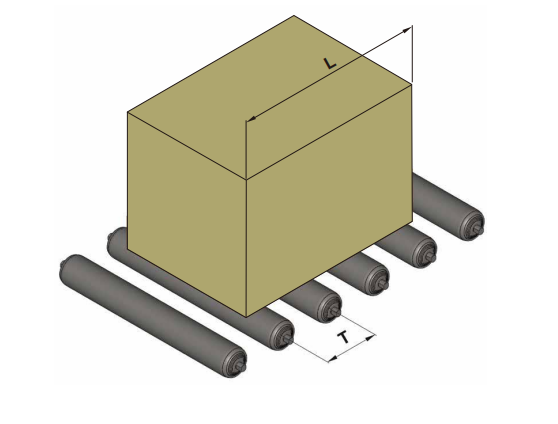
This principle is derived from the theory of continuous conveying machinery design and long-term engineering practice verification.
Its purpose is to ensure that the goods maintain a stable force-bearing state during the conveying process, avoiding tilting, oscillation or partial suspension due to insufficient support points.
Take the common courier cartons in the logistics industry as an example:
When the length of the goods is 600 millimeters, the center distance of the rollers is usually no more than 200 millimeters;
When the length of the goods is 450 millimeters, the center distance of the rollers is usually no more than 150 millimeters;
When the length of the goods is 300 millimeters, the center distance of the rollers is usually no more than 100 millimeters.
By ensuring at least three support points, the goods can maintain a good operating posture during the start, stop, and transfer processes, thereby improving the operational stability of the entire conveying line.
2、 Why is the roller spacing requirement more strict in the logistics and courier industry
Compared with traditional manufacturing, the logistics and courier industry has the following characteristics:
The size of packages varies greatly;
The conveying speed is high;
The conveying volume is large and continuous operation time is long;
There are a large number of merging, diversion and turning stations;
It is necessary to take into account future business growth and changes in goods specifications.
In actual operation, if the roller spacing is too large, shorter packages may be supported only by 1 to 2 rollers.
When the goods pass through the roller joint, transfer area or equipment interface, they are prone to shaking and posture changes, which will affect scanning recognition, automatic sorting and subsequent conveying processes.
Therefore, currently, the mainstream courier sorting centers in the design of conveying systems usually take the minimum package size that may occur in the system as the design basis, ensuring that all packages can meet the "three roller support principle".
3、 What problems will occur if the distance between the rollers is too large?
What problems will excessive roller spacing cause
A large number of engineering cases show that when the roller spacing exceeds the reasonable range, the following problems may occur:
1. Decrease in goods running stability
After the number of support points decreases, the center of gravity of the goods is likely to change, resulting in front-back oscillation or left-right deviation during the conveying process.
2. Decrease in transfer through rate
In the transfer area between equipment, if the bottom of the goods is insufficiently supported, abnormal situations such as box jamming or slanting of the box are prone to occur.
3. Decrease in automatic sorting accuracy
Modern logistics centers generally adopt barcode recognition and visual recognition technologies.
Unstable goods posture will affect the recognition efficiency of the scanning equipment, thereby reducing the overall sorting efficiency.
4. Increase in equipment wear
The goods frequently impact the rollers and frame, not only increasing noise but also accelerating the wear of roller bearings and transmission components.
5. Design suggestions for the logistics and courier industry
Based on the application experience of global large-scale courier distribution centers and automated logistics storage projects, the roller spacing design can refer to the following principles:
Minimum package lengthRecommended maximum roller spacing
Minimum package length | Recommended maximum roller spacing |
300 mm | 100 mm |
450 mm | 150 mm |
600 mm | 200 mm |
750mm | 250mm |
900mm | 300mm |
When designing the actual project, it is necessary to first conduct verification based on the minimum packaging size within the system, and ensure that the goods can receive continuous and stable support throughout the transportation process.
For the logistics and express delivery industry, the spacing between rollers is not necessarily more economical when it is larger, nor is it necessarily more reasonable when it is smaller.
The scientific design principle is to ensure that the goods can receive at least three effective rollers for support under any operating conditions, and to control the deformation within the range of the goods' span.